
Main Menu

China’s PTFE fuel hose market includes manufacturers serving automotive, motorsport, industrial, and fluid-transfer applications. This guide compares ten suppliers, focusing on product information that buyers can assess: tube construction, reinforcement options, temperature and pressure ratings, available sizes, documentation, and customization. A polished catalog is useful. It is not proof of performance.
PTFE Fuel Hose selection starts with the actual system requirements. Consider the fuel type, operating temperature, pressure pulses, bend radius, fitting compatibility, and installation environment. Ask for current technical data and confirm that ratings apply to the complete hose assembly, not only the PTFE liner. Details matter. A small mismatch at a fitting can undermine an otherwise suitable hose.
A sound engineering principle is: “Choose the hose for the operating conditions, then verify the assembled system.” No verifiable quotation from a named PTFE fuel-hose expert was provided, so this guide does not assign that statement to a real person. That distinction matters for trust. Manufacturer rankings also have limits; public information may be incomplete, and product ranges can change. Use this comparison as a starting point, then request specifications, samples, and relevant quality records directly from each supplier. Practical checks beat confident claims.
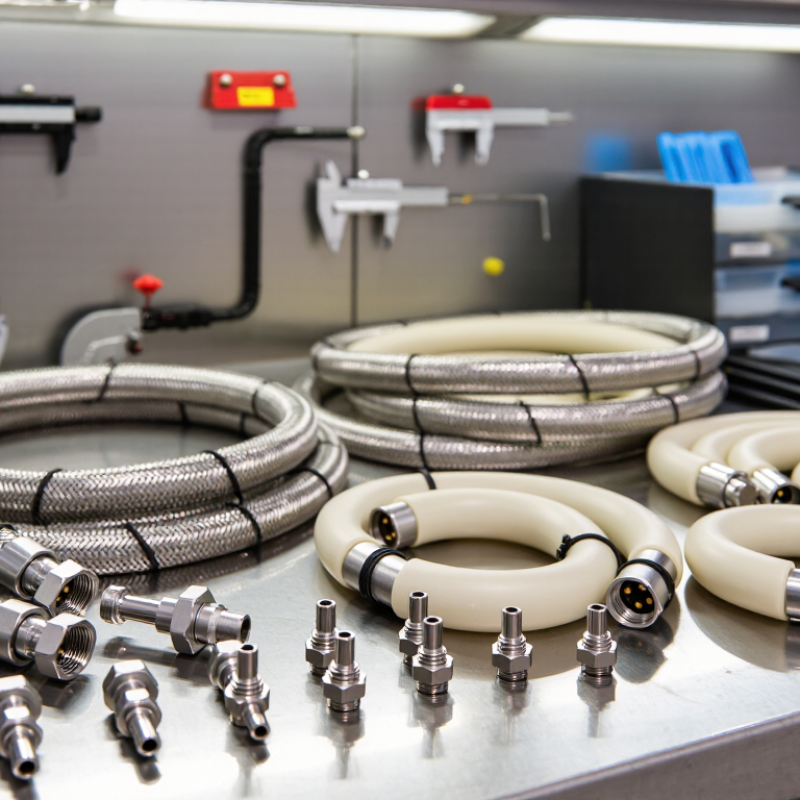
A PTFE fuel hose has a smooth fluoropolymer liner that helps resist fuel-related chemical attack and reduces friction as liquid flows. The liner is often reinforced with braided metal or textile layers, which carry pressure and protect against external damage. PTFE melts at roughly 327°C, but that figure is not a safe operating-temperature rating. Hose limits depend on construction, pressure, fittings, and exposure time.
Standards offer useful checks. SAE J30 specifies performance requirements for fuel and oil hoses, while ASTM D4894 covers PTFE molding and extrusion materials. These references address different parts of the system: a resin specification alone does not certify a finished hose. For an installation, check the hose maker’s stated pressure and temperature limits, fuel compatibility, bend radius, and fitting method. A tight bend near an engine can kink the assembly or concentrate stress at a connection.
PTFE hoses suit applications where chemical resistance and temperature stability matter, including fuel delivery and motorsport plumbing. They are not automatically the best choice for every vehicle. Some constructions are less flexible than rubber hose, and incorrect assembly can cause leaks even when the liner itself resists fuel. That detail is easy to miss. Inspect routing for abrasion, heat exposure, and movement before operation.
A practical guide to common PTFE fuel-hose applications and selection considerations. This table is not a verified manufacturer ranking.
| Application | Common Hose Configuration | Why PTFE Is Considered | Selection Considerations |
|---|---|---|---|
| Automotive fuel-injection supply | Smooth-bore PTFE liner with a suitable reinforcing braid | PTFE offers broad chemical resistance and low fuel permeation compared with many conventional elastomer hoses. | Confirm the complete hose-and-fitting assembly is rated for the system pressure, temperature, fuel, and intended installation. |
| Fuel-return lines | Smooth-bore or compatible flexible PTFE assembly | The liner can suit fuel-contact applications where resistance to fuel-related degradation is important. | Even return lines need suitable pressure, temperature, bend-radius, and fitting ratings. |
| Ethanol-blended gasoline applications | Fuel-compatible PTFE liner with application-rated end connections | PTFE is commonly selected for fuel systems that may encounter alcohol-blended fuels. | Verify compatibility with the specific fuel blend and with every wetted component, including seals and fittings. |
| Methanol-fueled performance engines | PTFE hose assembly selected for the fuel and operating conditions | PTFE’s chemical resistance makes it a material considered for specialized fuel service. | Check the hose, fittings, seals, and installation guidance for the exact methanol concentration and service conditions. |
| Diesel fuel supply and return | Smooth-bore PTFE assembly with a compatible reinforcement layer | A PTFE liner may be used where chemical resistance and low permeation are desired. | Check compatibility with the particular diesel formulation, additives, temperature range, and connection type. |
| Marine engine fuel systems | Marine-application-rated PTFE hose assembly | PTFE’s fuel resistance can be useful in marine fuel plumbing where an appropriate assembly is specified. | Use hose and fittings that meet the vessel’s applicable regulations and installation requirements; do not assume a general-purpose hose is approved. |
| Generators and small engines | Fuel-rated PTFE assembly sized for the equipment and routing | It may be considered for applications requiring a fuel-resistant liner and durable assembly. | Match the hose dimensions and ratings to the equipment manufacturer’s requirements and the actual fuel used. |
| Under-hood or elevated-temperature routing | PTFE liner with reinforcement and any required heat protection | PTFE can be useful in demanding thermal environments when the complete assembly is appropriately rated. | Observe the assembly’s temperature limits and protect it from exhaust heat, abrasion, sharp edges, and excessive bending. |
| Fuel systems requiring static-control measures | Conductive or static-dissipative PTFE design, where specified | Some hose designs are made to provide an electrical path through or along the liner. | Standard PTFE is not necessarily conductive. Verify electrical properties and follow the system’s bonding and grounding requirements. |
| Custom replacement or retrofit assemblies | Assembly chosen to match the original routing, bore, end connections, and service rating | PTFE assemblies are available in configurations suited to different routing and fuel-system needs. | Confirm end-fitting compatibility, installation clearance, bend radius, pressure and temperature ratings, and any required approvals before replacement. |
Note: PTFE hose performance depends on the liner, reinforcement, fittings, assembly method, and operating conditions. Always consult the assembly specifications and applicable regulations before installation.


