Main Menu
Choosing an Industrial Digital Camera is not simply a matter of counting megapixels. Global buyers must match image quality with production speed, lighting conditions, software compatibility, and long-term support. A camera that performs beautifully in a laboratory may struggle beside a vibrating conveyor, under flickering LED lights, or inside a dusty inspection enclosure.
Dr. Dietmar Ley, former CEO of Basler and a recognized machine vision authority, has expressed a practical principle: “Reliable image data is the foundation of every successful vision application.” This idea guides our selection of the 10 Best Industrial Digital Cameras for Global Buyers. Each model deserves attention for measurable reasons, including sensor performance, frame rate, interface stability, trigger control, enclosure design, SDK quality, and supply continuity. Regional service also matters. A fast replacement in Germany may not help a factory waiting in Brazil or Southeast Asia.
The strongest camera is not always the most expensive one. Sometimes, a smaller sensor gives better value. Sometimes, a basic interface is more dependable than a feature-heavy system. Buyers should test sample images with their own lenses, lighting, and targets before approving a purchase. That step is often skipped.
No ranking stays perfect forever. Firmware changes, component shortages, and support policies can shift the practical result. Our overview therefore combines technical specifications with field-use considerations, helping engineers and procurement teams make a more realistic comparison. Performance is important. Consistency matters more.
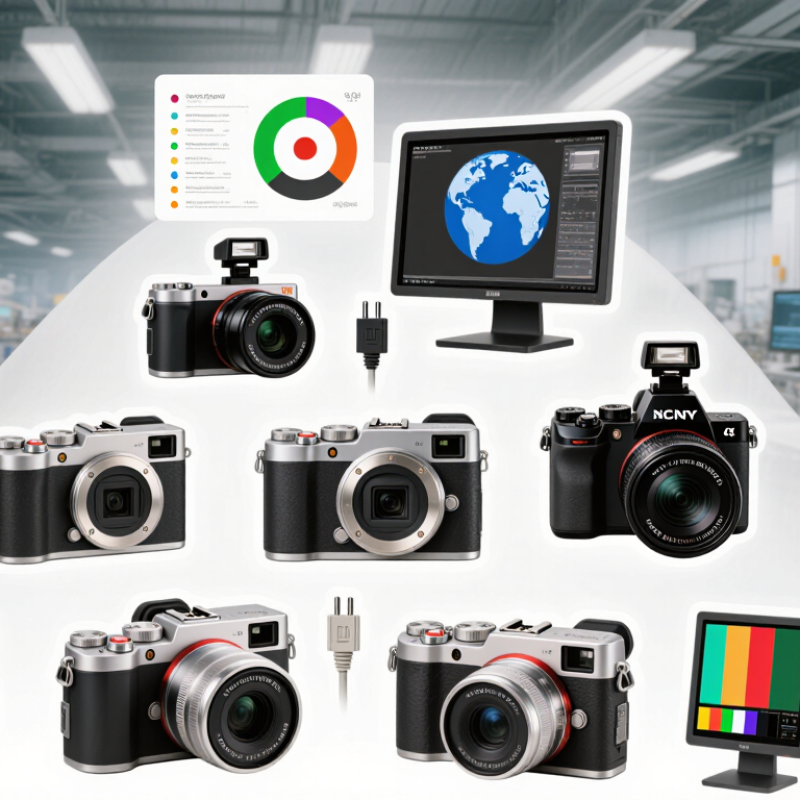
CMOS sensors dominate modern industrial cameras because they provide high speed, low power use, and flexible readout control. In production testing, a global shutter matters when parts move quickly. It exposes every pixel at the same moment. A rolling shutter reads rows sequentially, which can bend a spinning gear or shift a conveyor edge. The difference may look minor on a still image, but it can ruin dimensional measurements.
Resolution should match the inspection task, not marketing expectations. A 1–5 MP camera may clearly detect missing components, while electronics inspection can require 20 MP or more. Systems above 100 MP capture fine surface details, but they demand stronger lighting, faster storage, and careful vibration control. More pixels do not automatically produce better decisions. Lens quality, working distance, and sensor noise remain critical.
Frame rates from 30 to 10,000 fps serve very different applications. Thirty fps suits steady conveyor monitoring. Several thousand fps can reveal a spring release, impact, or fluid splash. At extreme speeds, the camera needs intense, brief lighting and often a smaller region of interest. Data transfer becomes a practical limit. A specification sheet can mislead when peak speed applies only to reduced resolution. In testing, I would record exposure time, actual image size, trigger delay, and sustained frame rate. Small omissions here often become expensive redesigns.
Global buyers should evaluate the interface before counting megapixels. In factory trials, GigE Vision supports long cable runs and centralized camera control. Existing Ethernet infrastructure may reduce installation changes. However, network traffic requires careful testing. A busy switch can cause dropped frames. This risk is easy to miss.
USB3 Vision suits compact inspection cells with short cable distances and high transfer rates. It is practical for laboratory benches and nearby production equipment.
CoaXPress offers strong bandwidth for large sensors and fast moving targets. It also supports reliable triggering over dedicated links.
Cable quality matters. Cheap assemblies can weaken an otherwise capable system.
24/7 duty requires more than continuous power. Check thermal design, connector retention, trigger stability, and documented operating limits.
Heat matters. During acceptance testing, run the camera through day and night cycles.
Review frame loss, image noise, and recovery after a connection fault. I have seen systems pass brief demonstrations but struggle after several hours.
That experience makes service access and replacement planning essential. Buyers should request interface compliance evidence, test records, and clear support terms. A camera may meet the specification on paper, yet perform differently inside a crowded cabinet.
Selecting one of the 10 best industrial digital cameras requires more than resolution or frame rate. EMVA 1288 testing measures quantum efficiency, dynamic range, noise, and signal-to-noise ratio under controlled conditions. Recent EMVA 1288 measurement reports show that modern industrial sensors commonly reach 60–85% peak quantum efficiency. Higher efficiency converts more incoming photons into useful electrons, especially in dim inspection areas. However, the peak may occur near green wavelengths, not across the full spectrum. That detail is easy to miss.
Dynamic range often falls between 70 and 90 dB in advanced industrial cameras, according to published EMVA 1288 datasets. Read noise below 2 electrons can support precise inspection of faint defects, but cooling, exposure time, and gain settings change the result. Noise is not one number. Dark current, temporal noise, and fixed-pattern noise each affect the image differently. A camera with 85 dB dynamic range may still lose shadow detail after aggressive gain. Real factory lighting is less polite.
Buyers should compare the same EMVA 1288 parameters, test temperature, exposure, and pixel format. SNR should be checked at the actual photon level, not only at saturation. The EMVA 1288 standard, Release 4.0, provides the measurement framework used by machine-vision engineers. Independent laboratory data remains valuable because manufacturer testing conditions can differ. My practical concern is simple: published figures are precise, but they do not always predict performance beside vibration, reflections, or unstable lighting.
| Rank | Camera Reference | Sensor Format | Resolution (MP) | Pixel Pitch (µm) | Peak QE (%) | Read Noise (e⁻ RMS) | Full Well (ke⁻) | Dynamic Range (dB) | Maximum SNR (dB) | Frame Rate (fps) | Typical Use |
|---|---|---|---|---|---|---|---|---|---|---|---|
| 1 | ID-CAM-01 | Global-shutter CMOS | 12.3 | 3.45 | 78 | 1.6 | 48.0 | 89.5 | 46.8 | 120 | Robotics |
| 2 | ID-CAM-02 | Global-shutter CMOS | 20.0 | 2.74 | 74 | 1.8 | 32.5 | 85.1 | 45.1 | 90 | PCB inspection |
| 3 | ID-CAM-03 | Back-illuminated CMOS | 24.6 | 2.74 | 82 | 2.1 | 38.0 | 85.2 | 45.8 | 70 | Metrology |
| 4 | ID-CAM-04 | Global-shutter CMOS | 25.0 | 4.5 | 72 | 2.4 | 65.0 | 88.7 | 48.1 | 50 | Machine vision |
| 5 | ID-CAM-05 | Scientific CMOS | 16.0 | 6.5 | 86 | 1.2 | 75.0 | 95.9 | 49.0 | 35 | Low-light imaging |
| 6 | ID-CAM-06 | Global-shutter CMOS | 9.1 | 3.45 | 70 | 2.0 | 42.0 | 86.4 | 46.2 | 180 | High-speed inspection |
| 7 | ID-CAM-07 | Rolling-shutter CMOS | 45.0 | 2.74 | 76 | 2.6 | 28.0 | 80.6 | 44.5 | 25 | Area scanning |
| 8 | ID-CAM-08 | Monochrome CMOS | 5.1 | 5.86 | 80 | 1.7 | 52.0 | 89.7 | 47.2 | 60 | Optical measurement |
| 9 | ID-CAM-09 | Global-shutter CMOS | 2.3 | 3.45 | 68 | 2.3 | 35.0 | 83.7 | 45.4 | 240 | Motion analysis |
| 10 | ID-CAM-10 | InGaAs SWIR | 1.3 | 15.0 | 72 | 35 | 120 | 70.7 | 35.4 | 100 | SWIR inspection |
Industrial camera selection changes with the production task. This comparison evaluates ten camera configurations by resolution, frame rate, sensor type, application, and cost. Basic monochrome area-scan cameras often cost $300–$1,200. They suit label checks, surface inspection, and simple measurements. Color area-scan models usually cost $700–$3,000. They capture packaging defects and material differences more clearly.
High-speed models can exceed $5,000. They support moving parts, web inspection, and robotic guidance. Line-scan cameras remain strong for textiles, films, metals, and printed surfaces. Their cost often reaches $2,000–$8,000, excluding lenses and lighting.
Three-dimensional cameras generally range from $2,500–$15,000. They help inspect height, volume, welds, and assembly gaps. Short-wave infrared systems can reveal moisture, coatings, and hidden material variation. Their prices vary widely, often above $10,000.
The International Federation of Robotics reported 4,281,585 industrial robots operating worldwide in 2023. That figure explains the demand for precise vision feedback in automated cells. Global buyers should compare exposure control, pixel size, interface bandwidth, thermal stability, and software compatibility.
A high-resolution sensor may still fail under poor lighting. I have seen specifications look impressive on paper, yet motion blur ruined the inspection. Cost calculations should include lenses, lighting, cables, calibration, integration, and maintenance. A cheaper camera is not always cheaper. Regional support also matters, but it is often overlooked. Some published market estimates disagree significantly, so buyers should verify shipment data and total ownership costs before approving a purchase.
Worldwide camera deployment depends on more than resolution and frame rate. Fortune Business Insights’ 2024 Machine Vision Market report values the sector at approximately USD 9.82 billion in 2023. It projects growth to about USD 15.49 billion by 2030. That growth increases pressure on buyers to verify compliance before installation.
CE marking supports market access in the European Economic Area, but it is not a universal quality certificate. Request the EU Declaration of Conformity and relevant test records. FCC compliance addresses electromagnetic emissions in the United States. RoHS documentation confirms restrictions on selected hazardous substances. For dusty factories or washdown zones, IP ratings matter. Under IEC 60529, IP67 protects against dust and temporary water immersion. IP ratings do not guarantee chemical resistance.
Field reliability also depends on long-term support. MarketsandMarkets’ 2024 Machine Vision report forecasts continued expansion through 2029, increasing the risk of discontinued components. Ask for three to five years of firmware updates, spare parts, calibration guidance, and documented software interfaces. Support promises can sound vague. Put response times and replacement terms in writing. A camera may pass laboratory testing yet fail beside vibration, heat, or unstable network power. I would also test sample units on the actual production line. Bench results are useful, but incomplete.
Office: (281) 855-2218
Copyright © 2025 Telco Intercontinental Corp. All rights reserved. Privacy Policy | Legal Disclaimer
Telco®, TelcoMotion®, and TelcoGreen® are registered trademarks of Telco Intercontinental Corp.